Brent Crude Oil is a naturally occurring fossil fuel extracted from the North Sea. It is widely refined into
products such as petrol, diesel, jet fuel and petrochemicals, making it a critical input for transportation,
manufacturing and global energy systems.
Highlights Mar 2025 – 2026
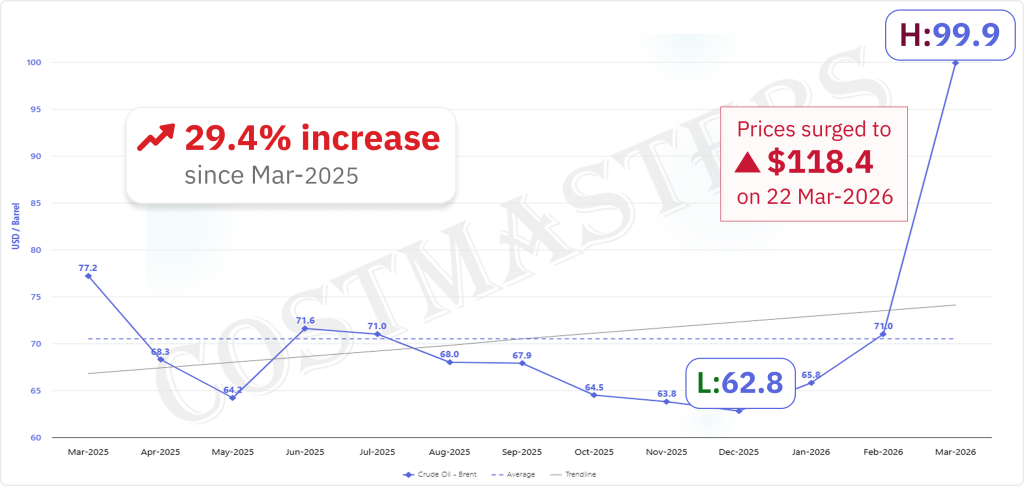
Crude oil posted its sharpest annual decline since 2020 in 2025, with Brent falling roughly 20–22%, as record global supply outpaced demand.
Brent crude fell below $63 per barrel in late December 2025, primarily because output consistently exceeded sluggish industrial consumption worldwide.
Brent soared to almost $118 in mid March because an Israeli airstrike hit Iran’s South Pars gas field.
Key Drivers
Compounded Oversupply
Record US output and aggressive OPEC+ production hikes flooded 2025 global markets, driving Brent crude prices strictly down amid weakening economic demand.
Strait of Hormuz Disruptions
The 2026 blockade of the Strait of Hormuz threatened 20% of global oil supply, forcing Brent crude prices massively up.
Red Sea Front Expansion
Yemen’s Houthi rebels joined the conflict in late March, threatening the Bab al-Mandeb chokepoint and spiking Brent prices up to $117.
Market Impact
Global Inventory Growth
Sustained 2025 oversupply pushed global inventories to a four-year high of 8.03 billion barrels in October 2025, continuing to climb through year-end as production steadily outpaced demand.
Domestic Import Costs
India’s crude basket reached $120 per barrel on 9 March 2026 due to Strait of Hormuz disruptions, significantly raising national import expenditures.
Future Outlook
Brent may surge toward $150 if Yemen’s Houthi involvement and Hormuz blockades persist, yet a stabilization near $70 is expected in one or two quarters, contingent on how quickly Middle East transit resumes.